Falls to forgotten meds: 8 preventable reasons older Americans end up in the ER
September 3, 2026



Roughly one in five people aged 50 or older now live alone, based on AARP data. Of those, about 60% feel at ease living alone and over half feel in control. Clearly, living alone isn’t a problem to be solved.
With this independence comes one important question: How will anyone find out if something goes awry? Based on Census data across the U.S., between 23.1% and 43.7% of adults older than 75 live alone.
Where you live can be a factor in how much risk you face. That’s why QMedic has compiled data on the states where most older adults live alone, primarily using Census and AARP data. The researchers paired that with risk mitigation techniques to help you stay safe while preserving your independence.
A fall, stroke, or medication mix-up is far more common the older you get. If you live on your own, the seriousness of such an event increases drastically as well. There may not be someone just down the hall to call 911 or to notice the initial signs that something may be wrong. For older adults living on their own, someone noticing can take hours or even days.
There are two other facts that exacerbate the risk. According to a 2025 AARP survey of more than 500 solo agers, aged 50 to 95, while many older adults are comfortable living on their own, two in five name loneliness as a challenging part of aging alone.
Additionally, in a 2021 study from the University of California, San Francisco, only about one-third mentioned knowing someone who could help manage their household if age became a deterrent to being able to do it themselves. Independence is important as you age, but so is establishing a strong backup support system.
The national average of older adults, defined as being over 75, living on their own, is 34%, according to the Census Bureau’s Annual Social and Economic Supplement data. This heatmap shows the breakout across the country:
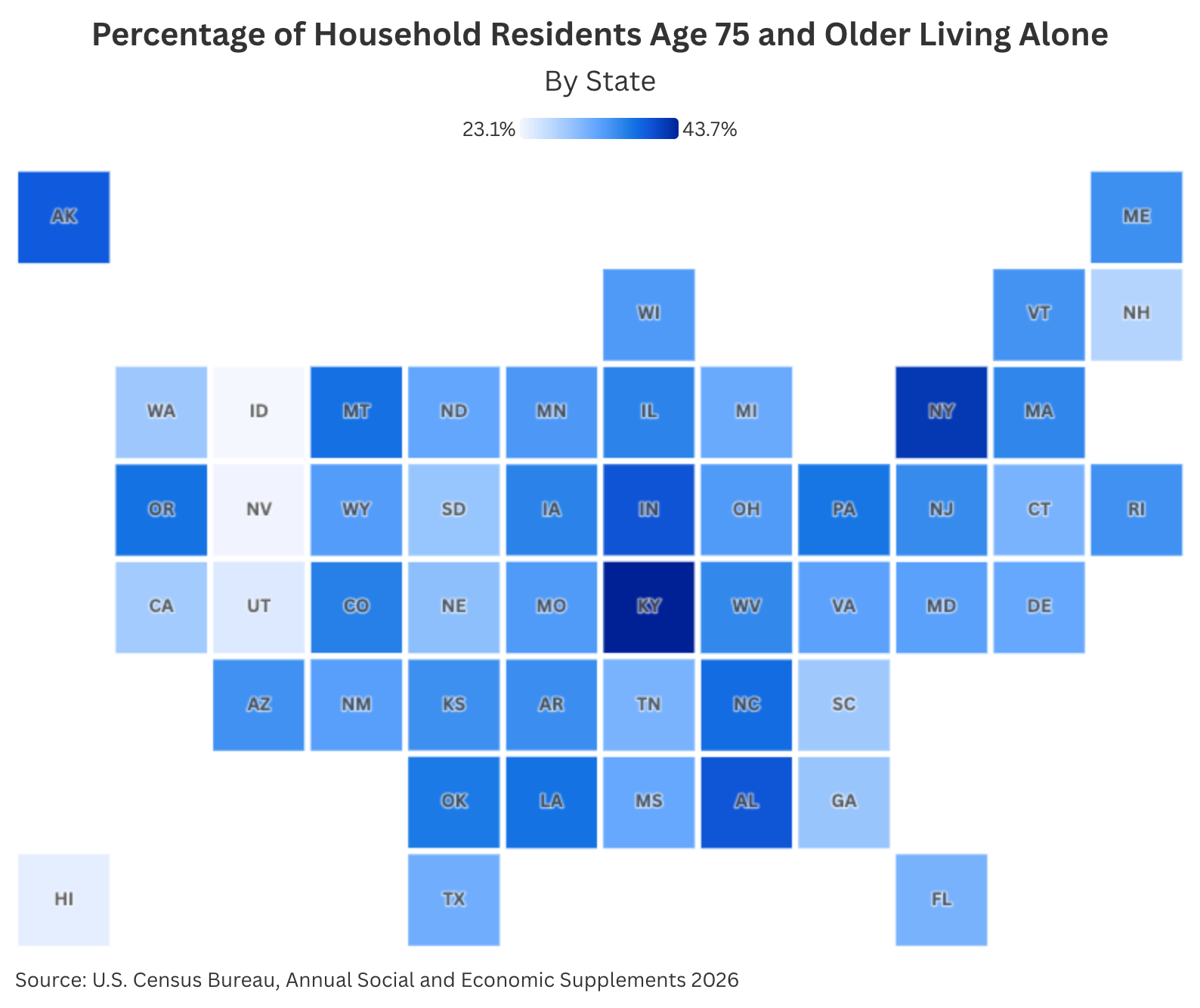
The spread between the state with the most solo livers and the least is 20.6 percentage points. A resident older than 75 in the highest state is nearly twice as likely to live alone as a counterpart in the lowest state. Kentucky and New York boast the highest rates of solo living among older adults. Indiana, Alabama, and Alaska are other standouts.
Idaho, Nevada, Hawaii, Utah, and New Hampshire have the fewest older adults living alone.
Rural Health Research Gateway, a federally funded summary, found that 28.2% of rural adults over 64 lived alone versus 26.8% in urban areas.
That’s not a significant difference, but where geography really comes into play is how long it takes to get help if something happens. Clinical data studying 1.8 million emergency medical response encounters back in 2015 found that median response times were six minutes in urban environments and 13 minutes in rural areas. The slowest 10% of rural calls could take nearly half an hour.
Just because someone is living alone doesn’t mean they’re far from family, but the distance has been growing. A 2019 study from the Joint Economic Committee of Congress found that, back in 1994, 68% of retiring adults lived within 10 miles of their adult child. By 2014, the share had dropped to 55%. The correlation was attributed to a drop in fertility rates, meaning older adults just had fewer children to live near.
And proximity matters in the first minutes after an accident or health scare.
Figuring out how long it takes to actually get help in the event of an emergency on a place-by-place basis is difficult. There’s no widely published database. However, certain states and cities, including Nebraska, Connecticut, and San Francisco, publish emergency medical services reports, which provide a good foundation.
Response time no longer matters if a person lives alone and can’t reach a phone after an accident. Setting a support system based on initial detection is crucial.
For anyone who has an older adult in their life, or if you are an older adult living on your own currently, there are four main questions to ask that can determine if you have an adequate support system:
Having someone nearby who stops in at regular intervals or gives you a scheduled phone call to check in can make all the difference in the case of an accident. It can also help to lessen feelings of loneliness with age. Consider wearing an alert button or having fall-detection tools in your home if you have concerns.
Above all else, you should try to set a key event as a sign to move in with someone else. Whether it’s a fall, sustained confusion, or simply age impeding daily tasks, have a catalyst in mind so you know when it’s time to make a change.
Independence past 75 is not evenly distributed across the country. Some states have nearly twice the share of older adults living alone.
Rural vs. urban doesn’t affect whether a person is more likely to live alone, but differing geographies can make a difference in the event of an accident. Retaining independence in old age doesn’t require constant company, but you want to be found quickly by someone who knows where you are and when or why you may need help.